Study abroad and the migration of Scholars & Professional is a pervasive phenomenon dating back as early as 500 – 300 B.C. when intellectuals migrated for gaining more knowledge & sharing it with other individual's.
Study abroad programs, defined as all educational programs that take place outside the geographical boundaries of the country of origin, have increasingly gained popularity and interest in the last few years.
Regional economies and communities are facing increasing economic, social and cultural hardship in many parts of the world as economies adjust to the demands of the new orders of commerce and governance. A part of this is the paradox that regional economies and communities can be either enhanced or disadvantaged by education & development or lack of it. The potential enhancement comes from the increased social, economic and cultural capital that comes from harnessing people skills by development of education in a community sense.
Rapid global development and a growing demand for cross-cultural adaptability in employee's puts pressure on study abroad programs to provide high quality outcomes for their growing enrollment. Although the majority of study abroad programs offer brief orientations to prepare and help students get the most out of their exposure to study abroad experiences, researchers have suggested that cross-cultural training prior to departure is needed to introduce sojourners to the importance of culture, and to the inevitable stresses that occur as people attempt to adjust to their new setting. Cross-cultural training usually includes awareness of culture and cultural differences, factual knowledge necessary for adjustment, challenges to people's emotional balance that intercultural experiences unavoidably bring, and opportunities to practice skills and behaviors that can assist people's adjustment. Research evidence indicates that these types of cross-cultural training programs build awareness of culture shock, develop interpersonal skills, facilitate cross-cultural effectiveness and increase cultural empathy.
Although governments throughout the world invest heavily in education, they spend remarkably little to monitor and evaluate their investment. Management of most of the world's education systems is done without adequate information and analysis. The international education database is often unreliable, and leaves out crucial measures of quality, process and output. Education research does not receive the same priority as research on agriculture, health or the economy. These shortcomings are due in part to the limited professional capacity most countries have to gather education statistics and carry out education research, along with strong resistance by educators and policymakers to being evaluated. Improvements will depend heavily on greater commitment at the political level to measuring education outputs, and on the emergence of global leadership in promoting comprehensive, reliable assessments of education systems.
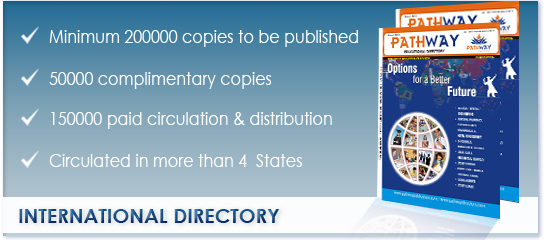
Unless students get a greater level of access and exposure to higher education & skill development, they will miss the opportunity, to turn the "educational gap into a growth opportunity for all, particularly for those who risk being left behind and being further marginalised". Education has a major role to play in seizing the growth opportunity - both as an enabler and as a user. Pathway International Education Directory is a knowledge sharing directory, with access to all that seeks to address this issue.
This directory features contributions from leading scholars from different countries who tackle the problems of teachers as well as students, and of planners as well as administrators. It presents authoritative overview articles, providing in-depth knowledge on various education hubs and the best educational institutions available within those countries.
Pathway aims to strengthen links between research and practice in growth & development in education for development in hitherto less developed parts of the world, e.g., developing countries (especially small states), and rural and remote regions of developed countries & other developing countries. Recognized as one of the leading international directory publisher on higher education studies, Pathway International Education Directory has put great emphasis on providing a space for institutional information related to benchmarked & renowned global institutions of repute for students and other institutions to jointly explore opportunities using an eclectic mix of information of various disciplines. It brings together information on various global education hubs, visa procedures & institutional listing from throughout the world in universities, polytechnics, colleges, and vocational and education institutions in order to assist in the transfer of best education practice & information to the student & educational community.
|